
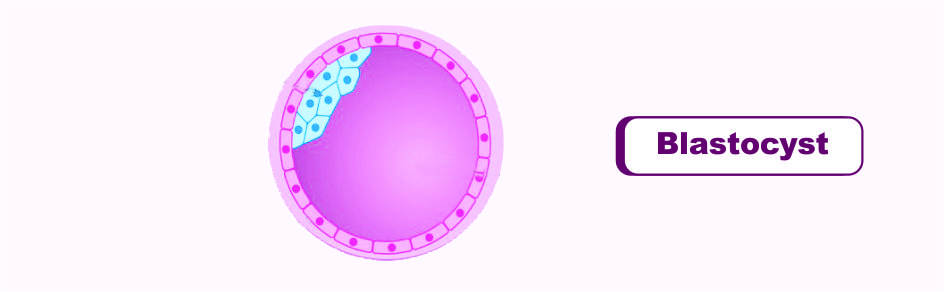
Blastocyst is the developmental stage of an embryo at day 5 of culture. Blastocyst has a fluid filled cavity with 2 different types of cells- trophoectoderm and inner cell mass. The grading of best quality blastocyst is done on basis of morphology and degree of expansion. In natural conception embryo reaches the uterus at blastocyst stage, hence transferring blastocyst is more physiological. Higher implantation potential and synchrony with endometrium makes blastocyst transfer an ideal choice to achieve a pregnancy.
Technically transferring a blastocyst gives highest pregnancy rate in an IVF cycle as they are the most robust embryos. Blastocyst transfer not only enables us to select the best embryo for transfer but also reduces the chances of multiple pregnancies by transferring a single embryo. Excess blastocysts can be frozen for later use.
Extended embryo culture or blastocyst culture is done in cases where we have good number of embryos at day 3 as not all embryos develop in to blastocyst. Although we at DREAMZ IVF aim for blastocyst transfer for all of our patients to achieve pregnancy, but it is specifically indicated in cases with repeated IVF failures, PGT or repeated miscarriages.

FAQs
1. What are the implantation stages?
The implantation stages include embryo hatching, attachment to the uterine lining, adhesion, and invasion into the endometrium, leading to the establishment of pregnancy.
2. A zygote divides to form which is implanted in the uterus?
A zygote divides to form a blastocyst, which is the stage that is implanted in the uterus and begins the implantation process.
3. What are the 4 stages of implantation?
The 4 stages of implantation are hatching, apposition (initial contact), adhesion (firm attachment), and invasion into the uterine lining.
4. What are the blastocyst transfer success rates?
Blastocyst transfer success rates are generally higher than earlier-stage embryo transfers, as blastocysts have better implantation potential. Success varies depending on age, embryo quality, and overall fertility health.
5. What is embryo transfer?
Embryo transfer is the process of placing a healthy embryo, usually at the blastocyst stage, into the uterus during an IVF cycle to achieve pregnancy.